School Rules
Learn about the school rules and expectations that help create a safe, respectful and conducive learning environment for every Bowenian.
In Bowen, we strive to create a caring and vibrant learning environment for Bowenians to ‘Do Well and Do Good’. Our rules describe the standard of conduct expected at all times. Our end-goal is to guide you to cultivate core values and habits and to become self-disciplined individuals of good character.
1. Be Respectful
Be respectful and courteous to schoolmates and staff at all times. Do not use coarse words or vulgarities, whether in person or online. The school adopts a zero-tolerance stand against bullying.
Uphold your reputation and the school’s reputation both in school and in public by being on your best behaviour, whether you are in school uniform or not. Take care of your personal safety and the safety of members of public.
Respect teachers’ personal space. The staff room is out of bounds to students. If you wish to see a teacher, use the phone outside the staff room to call the teacher and meet the teacher outside the staff room. If you need to telephone or to text your teacher, do so within daylight hours. Avoid night hours and weekends unless there is an emergency.
Students must attend the daily flag-raising ceremony. Students who are Singapore citizens must sing the National Anthem and take the Pledge. Students will take the Pledge with the right fist over the heart.
2. Be Responsible
Be responsible for your words and actions; take ownership for what you say and do. If you see others doing the wrong thing, e.g., bullying others, do the right thing and step in to correct the matter, or report it to a teacher.
During lessons, do not leave the classroom without permission from the teacher in class at that time. During recess, during PE lessons and after school, do not remain in class or loiter around the classroom blocks.
Be responsible for the cleanliness of your classroom. Food and bottled/packet drinks can only be consumed in the canteen.
Be responsible in managing and maintaining the cleanliness in the classrooms and/or special rooms after a lesson.
You are not allowed to bring any card games to school. These include cards like Poker, Collectible Cards, and various other card games that can simulate gambling in any form.
You are not allowed to smoke or possess any cigarettes, e-cigarettes, vaporizers, narcotics or illegal substances.
You are not allowed to consume or possess alcoholic beverages or beverages that resemble alcoholic beverages.
You are not allowed to have in your possession any weapon. You are also not allowed to bring any weapon-like item which can be used or intended to be used to cause harm to others.
You are not allowed to bring in any items which may constitute or pose a risk of a fire hazard. E.g., lighters, kerosene, sparklers etc.
Teenage years are growing-up years, where students develop healthy friendships with friends of same and opposite gender.
Platonic relationships which focus on mutual respect that builds healthy and rewarding relationships with friends are encouraged.
One-to-one, exclusive relationship with friends of the opposite gender or same gender are discouraged. We encourage students to make responsible choices so as to grow as an individual who contributes to self, family and society positively.
In addition, any messaging online or offline (e.g., suggestive / explicit content) or behaviour (e.g. holding hands, hugging or kissing) that is considered inappropriate for teenage years will be dealt with as disciplinary offences.
Examination Rules and Regulations
You must not commit or attempt any acts of dishonesty or support such acts. For example, writing information / notes on any part(s) of your body, taking the examination on someone else’s behalf, using unauthorised devices, or giving answers to or obtaining answers from another candidate.
You must not communicate or attempt to communicate with other candidate(s) / unauthorised person(s) during the examination, or during any occasion when communication is strictly prohibited. For example, when answer scripts are being collected, or during movement to the quarantine area.
You should only face the front and must not turn around during the examination.
You must not write or draw anything that is offensive or obscene in your answers.
You must not exhibit improper conduct or misbehaviour during the examination. For example, disturbing other candidates or disobeying instructions from examination personnel.
You must not leave the examination venue, quarantine or holding room unescorted or without permission from the examination personnel.
You must not flip open or turn over the question paper until you are instructed to do so.
You must stop writing and close the answer booklet (if applicable) after the invigilator has made the announcement to do so. You are to remain seated quietly while your answer script is being collected and counted.
You must be in an appropriate attire (School Smart Formal or Smart Casual attire).
If you are wearing an outerwear (e.g., jackets, cardigan, windbreaker, sweater) into the examination venue, you must ensure that your outerwear does not have any unauthorised materials or devices. You may be asked to remove the outerwear for checks before, during, and after the examination.
You are to obey any other instructions provided by the invigilator before, during and after the examination.
If you fail to comply with abovementioned rules and regulations or any other additional instructions for any specific examination paper or subject, you would be deemed to have breached the examination rules and regulations. As a result, you may have your results annulled or imposed with a grade penalty. Conduct grade may be adversely affected and the offence will be recorded.
Smartphones and Smartwatches
As part of Grow Well SG launched in Jan 2025, MOE has introduced enhanced measures in secondary schools to help students cultivate healthier screen use habits and better support student well-being in the digital age. Responsible use of smartphones and other digital devices (e.g. cameras, smartwatches, etc.) is expected of all students both in school and out of school. With the availability of PLDs, students will not need their smartphones/smartwatches for learning or accessing online learning materials. Hence, during curriculum hours (including recess, lunch breaks, CCAs, after-school programmes, enrichment programmes, extra/remediation lessons and learning journeys in general) all students are required to lock their smartphones/smartwatches in their personal lockers. Students are allowed to retrieve their smartphones/smartwatches from the lockers only after curriculum hours.
· Smartphones and smartwatches should be turned off during curriculum time and should not be a source of distraction during lessons. Use of hand phones and smartwatches is allowed only:
During lessons/activities, when specifically required by teachers for teaching and learning; and
End of curriculum time only at the foyer for communication with parents.
Use of smartphones and smartwatches is disallowed at all times in other areas. For example, canteen, classrooms, homerooms, library, science labs, computer labs, ISH / Hall / Field, corridors etc.
Students should communicate using messaging application and social media with respect and courtesy. The language and images used or transmitted must be respectful and free of coarse language, vulgarities and inappropriate pictures. This also includes emojis, stickers, and all other media transmitted or used via these applications. Students must also adhere to the age limit restrictions of social media and messaging apps.
It is the responsibility of students to exercise proper care of their hand phones, Smart watch, and PLDs to prevent loss, damage, and theft. The school may not investigate the theft of hand phones and PLDs. Students should be responsible for their phones / PLDs and should not
leave their hand phones / PLDs unattended
leave the hand phones / PLDs in open view, for instance, in the toilet, classroom and canteen.
3. Be Present
Attendance at school and school-related activities (e.g., CCA, Sports Day, Enrichment Days etc.) is compulsory, as regular attendance is crucial for the continuity of learning. Students who are absent must submit a valid medical certificate (MC) or a letter from parents with valid reasons immediately upon their return to school after they are absent. Students who are absent from school without either MC or parents’ letter stating a valid reason will be regarded as having committed truancy, which is a serious offence. Only MCs from doctors who are registered with the Singapore Medical Association will be accepted.
As it is important that students attend school regularly, we encourage parents/guardians to excuse their children from school through parents/guardians’ letters only for valid reasons such as unforeseen family circumstances. If students are unwell, we advise them to seek medical attention and be excused from school through an MC. We will allow students to be excused from school through parents/guardians’ letter only up to 5 letters per semester.
Poor attendance may affect the student’s conduct grade.
Our students’ safety, well-being and learning are our top priority. No student is allowed to leave the school during school hours (including lesson time, CCA time and other school activities) for any reason without permission. A student is only allowed to leave school before the official dismissal time if he/she: (a) has a valid reason and are granted approval, and (b) is picked up by his/her parent/guardian from the General Office.
4. Be Punctual
Students must be punctual for school, lessons, CCA and other school activities. Students should be at the flag-raising ceremony by 7.30 am.
Students who are late for school will have to explain themselves to the Discipline Teachers. Parents may be informed of late coming.
Persistent late coming to school, especially after Warning Letters are issued, will affect the conduct grade and will be recorded in the Report Book.
Students who are late for school are required to complete 1 hour Detention Class on the actual day that he/she is late. Do take note that students’ handphones will be retained for the day. The handphones will be returned to students after the completion of Detention Class which takes place after curriculum time.
5. Be Well-Groomed
5.1 Uniform and Attire
The school uniform is a key symbol of school identity. Students should wear the school uniform neatly and with pride. All students are to wear the prescribed school uniform and modification to the uniform is not allowed.
Overview of 2026 Attire and Uniform. Be well-groomed, every day.
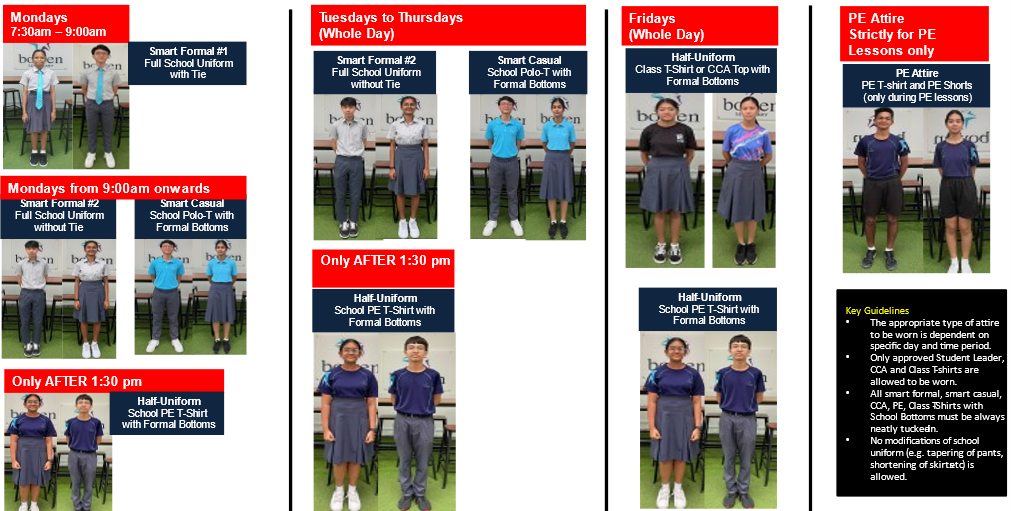
The Smart Formal Attire (shirt with trousers / shorts for boys, blouse with skirt for girls; with school tie) is compulsory for Monday mornings (7.30 a.m. to 9 a.m.) as the school will convene in the school hall for the weekly morning assembly. After 9 a.m., students can take off their ties and choose to change into the Smart Casual Attire (polo-shirt with trousers / shorts / skirt).
All students are allowed to change to PE T-shirt and formal school trousers/shorts/skirts after 1.30 p.m. (Mondays to Fridays).
For Fridays, deemed as Dress Down Day, students are allowed to report in their CCA, Class T-shirts, PE T-shirts or other approved school T-shirts and school trousers/shorts/skirts.
From Tuesdays to Fridays, both Smart Formal Attire (without school tie) and Smart Casual Attire may be worn.
The school shirt / blouse should not be worn with sleeves folded or with the topmost button fixed (except when the school tie is worn).
rouser modifications (e.g., tapering and skinny jeans style) are not allowed except for length adjustment. Only black or dark brown-coloured belts with plain buckles are allowed.
Skirt modifications are not allowed. Skirts must not be tight-fitted and must be at knee-length. Folding at the waistline of the skirts is also not allowed.
Students should in the Smart Formal/Casual attire during examinations and common tests.
Attire for PE Lessons: Students must wear their PE T-shirt and Bowen school black PE shorts for PE lessons. Other shorts besides Bowen school shorts are not allowed at all times. After PE lessons, students must change out of their PE attire and into their shirt / polo-shirt and formal attire bottoms (shorts / trousers / skirt) for classroom lessons.
School Tie (as part of Smart Formal Attire): The school tie should be worn on all morning assemblies on Mondays (Smart Formal Attire) and during formal school events (e.g., Speech Day). Students are also expected to wear their ties when attending formal events outside school such as when receiving Edusave awards, or when representing the school during formal events.
School Shoes: Students are allowed to wear track shoes in only black, white, grey, blue or purple colours (i.e. school colours) to school. Students may also choose to wear black canvas shoes with black or white shoelaces. Side rubber trimmings of the sole can either be black or white. Only white socks are allowed and must be worn such that the cuffs (top part) of the socks are visible
.No elaborate shoe design, colour and high-cut style sports shoes are allowed. Wearing of other footwear such as slippers is permissible only when accompanied by medical reasons. In such cases, students must produce a medical certificate or report.Students who come to school outside curriculum / CCA times, e.g., during school holidays
5.2 Hairstyles
Students are not allowed to dye/ tint/ bleach/ highlight their hair.
For boys
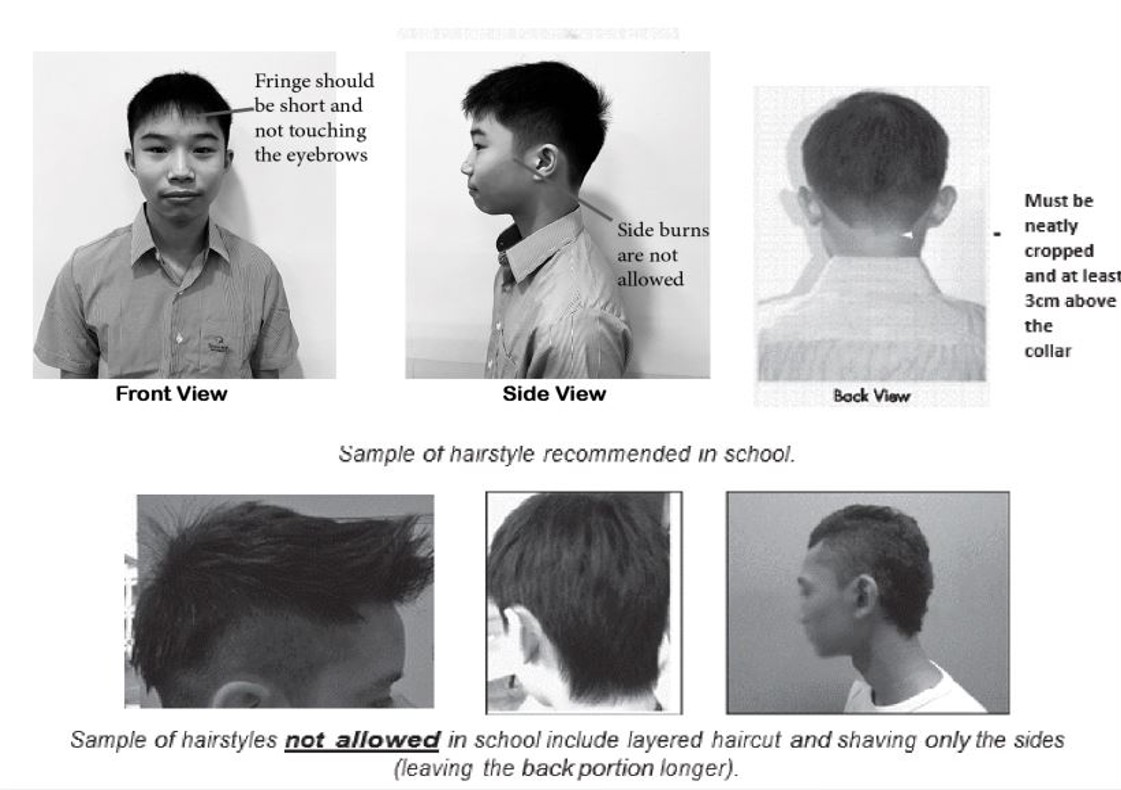
Hair should be short and neat and when combed downwards, should not touch the eyebrows, ears, or the shirt collar.
Hair at the back of the head must be cropped close to the nape of the neck and must be neatly sloped.
Outlandish styles are not allowed (e.g., very short hair at sides and very long hair at top or shave their hair).
Boys must be clean-shaven at all times. Moustaches, beards, goatees, or long sideburns are strictly forbidden.
For girls
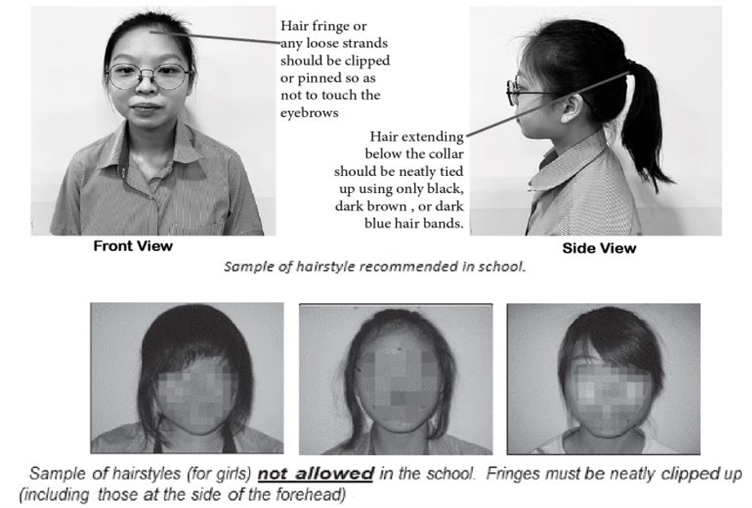
Girls should keep their hair neat at all times.
Hair extending below the collar should be neatly tied, pinned up or clipped.
The fringe should be neatly pinned or clipped so as not to touch the eyebrows.
Hair accessories like hair pins, hair bands or ribbons must be either black, dark brown or navy blue in colour.
5.3 Contact Lenses
Students who use contact lenses must not use coloured/ fanciful lenses.
5.5 Make Up and Body Art
Students are not allowed to use any form of make-up, except during school performances and with approval from the teachers-in- charge.
Body art / painting / piercing (e.g. nose and tongue, lip, eyebrow etc), including tattoos and henna paintings, are not allowed.
Alterations of eyebrows/eyelashes (including shaving/make-up/extensions) are not allowed.
5.4 Ornaments/Accessories
Rings, necklaces, lockets, fanciful earrings, large plastic ear-sticks, bracelets, anklets or other forms of jewellery or accessories/ornaments are not allowed.
Girls are allowed to wear only one small, simple ear stud on each ear lobe (diameter should not be more than 0.5cm). Only transparent ear sticks can be worn.
Boys are not allowed to wear ear studs or ear sticks.
5.5 Outerwear (jackets, sweaters, cardigan, windbreaker)
Students are allowed to bring an outerwear to school for the purpose of taking examination in the Home Rooms, if the student is feeling colder unwell, or during colder weather. Otherwise, if there is no explicit need to bring a jacket, students are not allowed to bring an outerwear.
Outerwear must be predominantly plain-coloured (black, blue, purple etc). Messages or images on the outerwear that are deemed to be offensive in nature are strictly not allowed.
Conclusion
Students who break the school rules will be guided firmly and fairly to reflect and learn from their mistakes. Educative measures such as ‘time out’ for reflection, warning letters, detention and service to school will be used to support the students’ learning. Where necessary, other measures such as surrendering of handphones to the Office during the school day, suspension in school, suspension at home and caning may also be used to help students to learn. Handphones may be retained to assist in school’s investigations for discipline offences.
This list of rules above can be summarised as – Be Respectful and Responsible. While the list is not exhaustive, students who are respectful and responsible will strive to do the right thing in all situations. We look to parents to work with the school as consistent and collaborative partners, so that we can achieve the goal of self-disciplined individuals of good character.
6. Responsible Use Policy
For Personal Learning Device & School ICT Resources
Introduction
Computing devices and access to the Internet have become a necessity for work, play and learning in the 21st century. Bowen Secondary school leverages ICT as an enabler for Teaching & Learning to foster the development of our students’ key digital literacies.
It is our goal to empower our students to make their Personal Learning Device (PLD) and internet experiences safe and responsible as they navigate the digital space. More information can be found in the at https://go.gov.sg/cw-studentkit (opens in new tab).
In addition, they are reminded to observe the guidelines stated in this Responsible Use Policy (RUP) on the use of PLDs and the school’s ICT resources. ICT resources include the following, but are not limited to, MOE/school-deployed ICT system accounts, the device management application (DMA) and school’s internet network. The aim of this RUP is to ensure that students will benefit from the learning opportunities afforded by technology in a safe and responsible manner.
Our vision is that key stakeholders - the school, parents and students - collaborate together to create an engaging and effective environment that better equips our students for the 21st century.
In the event that any Bowenian breaches the Responsible Use Policy For Personal Learning Device & School ICT Resources, the student(s) will face disciplinary action(s).
Responsibilities of Student as User
Students are responsible for their PLD. In the event of loss or theft of the device, they must make a police report and report the matter to the school.
Students must ensure that PLDs are kept in their lockers when they are going for PE, recess/lunch, CCAs or other times when they do not need their devices.
Students are responsible for the usage of PLD as and when instructed by teachers. When a PLD is not in use, it should be kept in assigned lockers securely.
In order to have a seamless learning experience, students are to ensure that their PLDs are fully charged before bringing them to school. Should students need to charge their PLD in school, they should only do so at the school's designated ICT Service Desk (D&T Block C Level 4-04), during recess/lunch and within IT Helpdesk opening hours.
All PLDs are installed with a device management application (DMA) to support a safe and conducive learning environment. Students should not attempt to uninstall the DMA or de-enroll the PLD from the DMA.
Students should not attempt to access data, system and information that they are not authorised to.
Students are reminded that the use of PLDs and school's ICT resources should solely be for the purpose of learning.
Students should not use any devices / account to
store, modify, create, share or circulate content (e.g., documents, presentations, pictures, websites, videos, etc.) that is inappropriate (e.g., indecent, pornographic, defamatory, hurtful to self or others)
conduct any illegal or unethical activities. These include cyber-bullying, posting online remarks that are racially or religiously insensitive, vulgar and/or offensive statements, disruptive of public order and intentionally causing emotional distress/harm to others.
make threats, cause harassment or embarrassment, impersonate or intimidate others as they are chargeable offences under the Singapore Legal System
hack any online/offline system through taking advantage of security loopholes or vulnerabilities or use of trojan/virus or any other means.
make repeated and intentional attempts to bypass the security systems in place to access restricted content or websites.
The above are examples of possible infringement and are not limited to the list above.
Students should not use MOE/school-deployed ICT system or accounts (e.g., Student iCON) for any commercial activities (e.g., buying and selling of goods and services).
Students are solely responsible for the security of their account Identity (ID) and password. Account IDs and passwords should be kept secret and not be shared with anyone.
Sharing of accounts across users is strictly prohibited. Students should not use another person's (student or staff) account as all accounts belonging to others are considered private. Doing so will be considered as identity theft or impersonation.
Students in need of email access for academic reasons are only allowed email access through an address assigned by the school. This email access is through a Google Gmail system managed by MOE. The interface is monitored by network administrators and is subject to filtering of inappropriate content. Email is subject to inspection at any time by authorised school administrators.
Students should not send mass emails, chain letters or spam.
Students are not allowed to engage in private chatting during class without permission from the teacher.
Students are expected to observe proper netiquette and decorum (rules on accepted/proper pro-social behaviours when using the Internet) and to remain respectful, courteous, and kind in all online interactions.
Students must stay engaged during lessons and must not be using any form of instant messaging applications/platforms, play games and/or indulge in entertainment in the form of listening to or viewing different types of media (videos, music, songs, etc) on their PLD, when it is clearly not a stipulated activity designed/included by the teacher.
Students shall not go into any chat room or Video Conference room (e.g., Zoom, MS Team Meeting, webinar or google meet) for which they are not authorised to and or other than those set up by their teachers or mandated in other distance education courses.
Students must not open, use, or change computer files that do not belong to them.
Students must not reveal their personal details e.g., their full name, phone number, home address, NRIC/BC, passwords, or reveal the personal information and details of other people. This includes not disclosing personal access credentials or sensitive personal data on AI platforms.
Students should verify the credibility of online content before sharing and avoid clicking on suspicious links or downloading unknown files.
If students inadvertently access a website that contains obscene, pornographic, or otherwise offensive material, they are to notify a teacher or the Principal immediately so that such sites are blocked from further access. This is not a request. It is a responsibility.
Students must remember that network storage is not guaranteed to be private or confidential. The Administration reserves the right to inspect their files at any time and will take the necessary actions if the files are in violation of the school's Responsible Use Policy.
Students are reminded to obtain explicit permission from the content owner before downloading, copying or sharing any copyrighted materials (e.g., text, images, videos and/or music).
Students should not use, copy, share or circulate digital files in an unauthorised or illegal manner.
Use of Artificial Intelligence (AI)
Students must ensure that they meet the minimum age requirement specified in each AI tool's age restrictions before using it.
If the use of AI is permitted, students must acknowledge the use of AI in weighted assessments and homework as required.
Students are to practice academic integrity and be responsible for their own learning when using AI. Students who pass off other's work as their own are ultimately short-changing themselves.
Students should exercise caution regarding the limitations of AI tools, including potential inaccuracies, fabricated responses, inherent biases and outdated information.
Digital Wellbeing and Balance
Students are reminded to balance screen time with other activities including physical exercise and face-to-face social interactions.
Students should avoid excessive use of their devices outside learning hours.
Students should take regular breaks to rest their eyes and mind during device usage.
Students are reminded to practice good sleep hygiene by not using their devices one hour before bedtime.
Consequences
Non-compliance may lead to disciplinary action in accordance with the school's discipline policy. Student(s) who fail to comply with the Responsible Use Policy may have disciplinary action(s) taken against them. The school has the right to impound the device for investigation purposes. The school may also generate students' PLD activities or even impound devices for external agencies.
Student(s) who fail to comply with the Responsible Use Policy may have disciplinary measures taken against them, depending on the nature and severity of the offence, such as but not limited to:
Warning
informing parents,
"Lock down" of PLDs,
School suspension,
impounding of devices,
referral to external agencies such as the Singapore Police Force.
In the event that students continue to make repeated offences, he/she will be subjected to harsher disciplinary measures which may include school suspension, impounding of PLD device, or referral to external agencies such as the Singapore Police Force for investigation.